


-02-01_edited.jpg)
Linen: A Millennia-Old Fiber at the Heart of Civilizations


Long before the industrial era, long before cotton or synthetic fibers, linen was already accompanying human civilizations. Cultivated for over 8,000 years, linen is one of the oldest known textile plants, deeply connected to the history of living, clothing, and everyday objects.
From Ancient Egypt to medieval Europe, linen has always been synonymous with purity, durability, and technical mastery.
A Naturally European Geography
Although linen originated in the Fertile Crescent, it was in Europe that it found its true land of excellence over the centuries.The rare combination of a temperate climate, regular humidity, and fertile soils made certain regions ideal for its cultivation.
Today, France, Belgium, and the Netherlands account for more than 80% of the world’s high-quality textile linen production. Normandy, Hauts-de-France, and Flanders continue to uphold a unique agricultural expertise based on soil-respectful practices, low water requirements, and the absence of artificial irrigation.
Linen grows quickly, captures carbon, enriches crop rotations, and generates no waste: the entire plant is used.
From Plant to Fiber: A Process of Great Finesse
The production of linen fiber relies on a precise sequence of stages inherited from ancestral know-how:
pulling, which preserves the full length of the fiber,
retting, a natural process in which rain and time release the fiber from the stem,
scutching, which mechanically separates the long fibers,
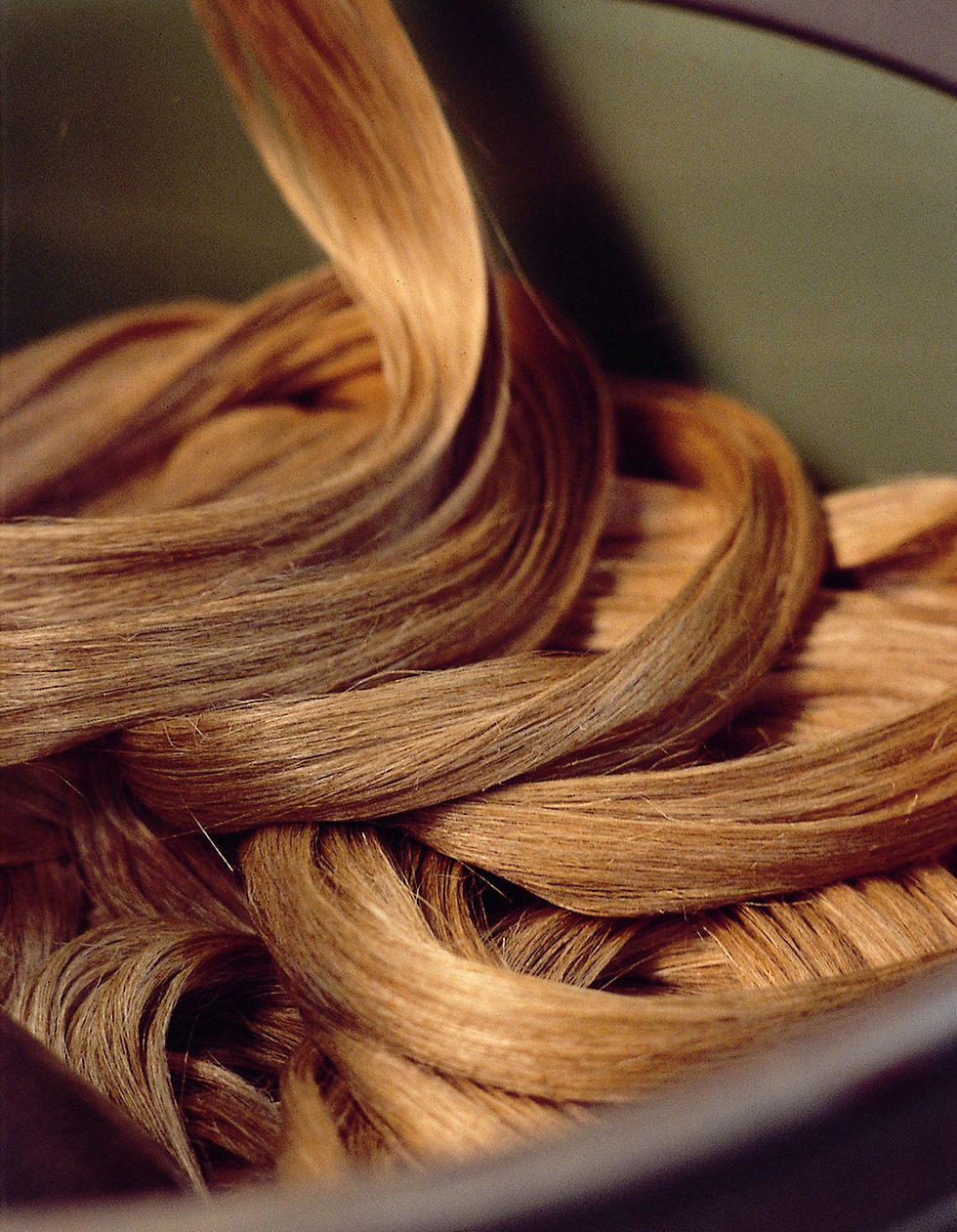
hackling, which refines, sorts, and aligns the fibers.
This slow and demanding process is built on patience and observation. Time is an ally, never an enemy.
Traditionally, these fibers were spun and then woven to produce fabrics for household linen, clothing, and furnishings. The thread was the very core of textile production.
From Thread to Material: A Silent Revolution
Today, a profound transformation is taking place.Linen is no longer limited to textiles: it becomes a material.
Thanks to technological advances, linen fibers can now be used without being spun, in the form of oriented, layered, and structured fiber sheets. This approach preserves the length, strength, and mechanical integrity of the fiber, while opening entirely new fields of application.
It is here that a decisive innovation emerges: linen multiaxials.
Linen Multiaxials: An Exclusive Development for SaintLuc
Unlike traditional woven fabrics, multiaxials are not made from interlaced yarns, but from continuous fibers oriented along multiple axes (0°, 45°, 90°). This architecture makes it possible to respond precisely to mechanical stresses while optimizing lightness and durability.
For SaintLuc, these linen multiaxials are developed exclusively, within a logic of continuity between culture, material, and use. They are neither decorative nor anecdotal: they are structural.
By working directly with linen fibers — without yarn, without twisting, without loss — SaintLuc reconnects with a form of material truth. The fabric becomes a technical skin, a form-giving support, a load-bearing element capable of reinforcing and expressing design.
From Field to Object: A Coherent Vision
From European flax fields to contemporary furniture objects, the same philosophy is expressed:respect for time, intelligence of material, and refusal of the superfluous.
Linen multiaxials are not a break with tradition, but its natural continuation. They embody a vision in which the past feeds innovation, agricultural culture meets design, and durability is not a promise, but a tangible reality.
At SaintLuc, linen is not merely a fiber.It is a culture, a geography, a memory — and now, a language of creation.


Comments